I intend to update this blog every week. This implies that I will not respond to individual comments on a one-to-one basis, but rather comment on ideas, criticisms, or responses once a week. However, it would be greatly appreciated if participants in the exercise respond to contributions of individuals who either differ from or support the ideas I proffer. This development would be extremely valuable because it might trigger research areas for potential researchers who may discover new topics to investigate, potentially leading to premises that could inform approaches beyond what is currently perceived as “education,” which is often seen as the key to success.
Sundays would be most convenient for me to post, and hopefully, by every following Sunday, I would be able to respond to contributions made in the interim period.
As intimated in my previous post, this project flows from my publication, “It is About I” in 2015 and preparation for my latest work, I will continue to grab bites from “It is About I”. I am doing this to give you an idea of how my mind works as well as to psychologically prepare myself for this leap of faith, which almost defies everything I have learned and taught for most of my life in schools.
Here goes:
Any group wishing to function in harmony needs a set of guidelines or rules to govern their actions. Should any of these rules be breached, there should be measures in place to ensure that members are discouraged from flaunting them. This is not a new concept and history of mankind is drenched with reactions or punitive measures stemming from disregard of what was agreed upon as acceptable or appropriate behaviour. As man has become more civilised, even punitive measures have come under scrutiny and modern thinking is more inclined towards correctional measures. The bottom- line however is that we need rules or guidelines or laws to ensure that societies function optimally. (p9/10)
Man had always tried and is still trying to understand elements of his existence and the universe. With the technology as well as knowledge at our current disposal, things that proved mysterious to our ancestors had become more understandable and there appears to be no limit to discovery and invention. Getting to know that which is beyond human understanding was and will remain an indefinite desire. Despite what is known today, there is still so much that we do not know, and it is the existence of that which we do not know that takes us to a plane of realisation that there is something beyond our mere mortal understanding and possibility. (p11/12)
At the point where human or physical jurisdiction expires, a need to invoke the assistance of a power or powers beyond humanness is compelled. This appears to have set the premise for what could commonly be referred to as religion. Generally, religion has a hierarchical structure in a triangular form.
Figure 1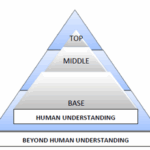 (p 13)
Our quest for survival has not changed for thousands of years and the organisation of society is part of human strategy to secure survival. Agreement to common rules of conduct and measures to address misconduct is a natural consequence of human attempts to engender functionality. The likelihood of any organisation operating without rules, guidelines or laws is remote and history abounds with record thereof. (p 15)
There is little doubt that attempts to organise life within communities is probably as old as being human itself. Why is it then that we still fail to reach that state of harmonious co-inhabitation of such a relatively small and probably the only habitable area in the universe known to us? (p 18)
Enough for now.
Please note that I am still sharing excerpts from “It is about I” I have not started on my new revelations yet. Until next Sunday…,