6 (MAYBE) OUR BIGGEST CHALLENGE
6.1 Language of Learning and Teaching (LOLT)
I believe that children learn best in their mother tongue and fully concur with the following statements,
- “…the use of what is to many children a foreign language, is one of the main barriers to teaching and learning.” (Bot,1993 as cited by Czerniewics, Murray and Probyn; 2000:7)
- “the second and more important reason why schooling is not effective for the majority of children is that most children have to learn through a language other than their own” (Macdonald, 1991)
- “Many children fail because they do not understand the language through which lessons are taught” (Luvija,1958,25 as cited by Mahlalela-Thusi and Heugh in Perspectives in Education 2002:241)
Although numerous researchers have demonstrated that mother tongue instruction is the most effective vehicle for learning, parents prefer to enrol their children in English-medium schools because they believe the language is internationally competitive. In their opinion, English is spoken almost everywhere in the world, and they also argue that educational resources in our country are more readily available in English.
It then begs the question, why parents still favour English instruction for their children despite massive evidence not in favour thereof? Why do parents complain about the demise of cultural heritage when this tendency can be directly linked to the fact that language is a “vehicle of culture”? (Mathe, 2002)
Why do parents want their children to be taught in English despite Government initiatives to promote mother-tongue education? Why the almost disregard for the fact that it is enshrined in the Constitution? Why would there be “a desire by some parents to educate their children in English, to the point of sacrificing their ancestral languages”? (Mathe, 2002)
According to Güles parents believe that English will secure “socioeconomic benefits”. (Güles, 2005) And another reason is that “parents perceive English as the global language” and fear that their children will be left behind. (Czerniewics, 2000)
The use of dated references shows that the tendency to opt for English as LOLT is still a preferred choice in the country after more than 30 years. Should one consider the great political value attached to the idea of delivering textbooks on time, one wonders about the less publicised inability of children being able to access the profound literary treasures locked between the covers of these books. Despite varied pedagogic approaches and commendable efforts of mediating learning through practical experience, the main determiner of scholastic progress in our schools is measured through text. The fact that children are both taught and assessed in language suggests that those with reading deficiencies, as well as an inability to express their understanding in writing, find it difficult to keep up with their more able peers.
Mathe is suggesting that children who do not learn in their mother tongue are not able to understand the concepts that go with learning. “These aspects include reading and writing (spelling) problems and inability to tackle the disciplines such as science and mathematics” (Mathe, 2002). In a study entitled “African Voices”, Vic Webb and Kembo-Sure identified three areas of concern regarding learners who do not learn in their mother tongue:
- Their ability to acquire and process knowledge is compromised
- “…meaningful and effective educational development cannot take place in a language that he or she did not grow up with.”
- “…the proficiency in the language on the part of the young learner remains poor.” (Webb)
Some researchers have even suggested that the “foreign” language problem is not only confined to learners, but to teachers who must teach in a language other than their mother tongue, as well. There might be substance in the following comment of Lucy Moyane, Director for school education in the National Department of Education, “In the classroom, for instance, there is evidence that both teachers and learners battle in their second language.” (Moyane as cited by Nicky Güles in Insight and Opinion 2005)
Despite my full understanding of the benefits of teaching a child in his mother tongue, perhaps the time has arrived in our country to consider accommodating the desires of our parents. It appears that our education clients prefer English as a medium of instruction, and maybe we need to put more effort into the acquisition of English. Should this approach be favoured, it would still be of great importance that our learners be taught in their mother tongue in Pre-school and the Foundation Phase and thereafter to gradually acquire English as LOLT in the Intermediate Phase. I believe that all our children should experience (ECD) Early Childhood Development, where they are prepared for formal schooling that starts at Grade R. The language in ECD is their mother tongue, and this start to schooling must happen in their mother tongue for the reasons emphasised by the numerous researchers in this regard.
Many people who know me and those who attended my classes may ask why I now, as an Afrikaans-Home Language speaker, appear to support the use of English as LOLT? This sudden change of opinion is well-considered and not only backed by what I have observed during my involvement in schools and schooling over the years but also by looking at the findings of researchers who have observed the preference for English during their research. The introduction of a paper written by Motseke (Motseke, 2020) reads as follows,
“The use of English as a language of business and communication in the world has increased the demand for instruction in English in non-English-speaking countries, with the result that the majority of English teachers in the world are non-native English speakers” (Camiciottoli, 2020: 97; Jeon, 2020: 3). (As cited by Motseke, 2020)
I do not think that we have been able to change this view in our country, and certainly we will not lose our culture or our language if we embark on this route, because for as long as we use our languages in contexts like home, customs and rituals, the future of our languages is secured. One of our biggest constraints in public mainstream schools is the availability of appropriate resources in our respective home languages. To wait for all our resources to be translated into all our national languages will take a long time and could compromise our ability to compete at the local as well as international level. Something is being whispered loudly in our country’s ears. What can that something be? Is it perhaps the 2021 results of PIRLS that revealed that learners who were tested in English and Afrikaans scored well above those who were tested in other Home Languages of our country?
Is it possible that we are not addressing the main reason for the discrepancy between the examination results of mainstream public schools and ex-Model C schools, but are reluctant to address the elephant in the room?
A cursory look at the PIRLS reports that were conducted every 5 years since 2001 suggests that we are not making enough progress in the language field. (PIRLS) The Progress in International Reading Literacy Studies is a comparative study conducted by Boston College’s Lynch School of Education and Human Development. Every 5 years, they compare the reading achievement of fourth-grade learners’ reading literacy. In 2001 South Africa ranked 30th out of a total of 32 countries. In 2006, both grade 4 and Grade 5 learners were tested, and both grades performed well below the international average. I am skipping to 2016 because in that year we were placed last out of 50 participating countries and elicited the following observation, “The study also revealed that there was no significant progress in reading literacy achievement since 2011”. https://tinyurl.com/268lx7mv
Fast forward to 2021.
“In 2021, 81% of Grade 4 learners cannot read for meaning in any language, up from 78% in 2016. This means that only 19% of South African Grade 4 children could read for meaning in any language in 2021 (all 11 languages were assessed). Because PIRLS is a nationally representative sample, of the 1,127,877 Grade 4 students in 2021, 914,000 could not read for meaning in any language. SA’s PIRLS score dropped from 320. We have lost a decade of progress. Between 2006 and 2016, the percentage of children who could not read declined from 87% (2006) to 82% (2011) to 78% (2016), but has now increased back to 81% (2021), wiping out a decade of slow progress and taking us back to 2011 levels of achievement. (2016) to 288 (2021), approximately 0,8 years of learning.
We have lost a decade of progress. Between 2006 and 2016, the percentage of children who could not read declined from 87% (2006) to 82% (2011) to 78% (2016), but has now increased back to 81% (2021), wiping out a decade of slow progress and taking us back to 2011 levels of achievement.” https://tinyurl.com/2do9976k
This is a clear indication that we have experienced and are still experiencing a language problem. If this is true, why do we not embark on a vigorous English as LOLT language drive that starts in the intermediate phase? I share an idea of this approach in Figure 7 in Section 5.2.2.3 on decentralisation. Kindly refer to Intermediate Phase Grades (4, 5, and 6) in Figure 7.
I am proposing the cessation of text-driven exams till the end of the Intermediate Phase. Instead of written sit-down exams, the current syllabi in these grades could be used to work on the ability of learners to orally express their understanding of what they have read. The same content currently used in the different learning areas could be used as reading material, and their understanding thereof should be assessed orally. The focus should not be to assess how many facts they can recall, but rather an assessment of how well they can explain information or processes and the manipulation of mathematical concepts they have read or been taught.
After all these years, I realise how mechanical the language teaching process is/was. Language in our schools is split into sections like Reading, Writing, Language, Literature, etc. In the Language section, it is further divided into Comprehension, Visual Literacy, etc. For external examination purposes, one of the only components that could give one a good idea of whether a learner can speak a language well is the oral examination done internally. Learners can easily remember one mouse, many mice or the spelling of words in their plural form, diminutives, and opposites of words without being able to speak or understand a language. If one adds the possibility of learners reaching grade 12 without having passed any grade after grade 7 due to the rule that any learner may only “fail” once in any phase, a matric certificate might indicate a pass in English without that learner being able to express him/herself in English with confidence. This possibility speaks directly to the purpose of education that seeks to facilitate the transition of learners from educational institutions to the workplace, and provides employers with a sufficient profile of a learner’s competencies. https://tinyurl.com/2y364dz2 (p4 b.)
This is a possibility that could emerge after 12 years of township mainstream schooling, and it makes one wonder how it is possible for immigrants to speak any of our local languages fluently after only one or two years in our country.
In conclusion to this “language” idea, I have a feeling that we are going to remain behind in this international race, and we need to address this mainstream gauntlet. We should start looking for ways and means to accelerate the acquisition of English to access learning material, albeit via print, aural or any visual medium.
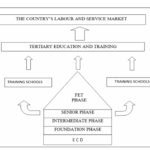
Here follows an idea I labelled “Leave no one Behind”. Besides that, it might accelerate our preparation of people who would be less dependent on Governmental support, but also people who might turn out to be more knowledgeable in their respective vocational fields. This model could also produce more individuals who would be able to create employment in our country.
This model suggests that we start at the back-end of the labour chain. This means that we look at what our country needs in terms of employment to take the country forward. If we need lawyers, we should start orienting our learners at an earlier stage in their school career. If we need skilled workers in vehicle mechanics, especially in view of the rapid current technological advances made in the industry, we need not wait for learners to pass grade 12. Learners should be schooled towards a need, and their schooling should follow a curriculum that will steer them in that direction. This career path should include subjects that would assist in the development of entrepreneurs and creators of employment.
Whereas Figure 7 intends to show how our current framework could be adapted to accommodate the model that I label “ Leave No One Behind”, the list below represents an example of what I think could be done. This list is not by any means conclusive and needs the scrutiny of curriculum experts, subject specialists, etc. It is a broad outline, and the idea is to use the current syllabus up to the end of the Intermediate phase, not only to allow for time in which to develop material for the Senior and FET phases, but also to hone the learners’ ability to communicate fluently in English. Emphasis is on reading with understanding, hence the oral explanation of concepts. Assessment is being done by oral explanation with or without props.
THE LIST BELOW IN TABLE FORMAT
|
Early Childhood Development (ECD) The current program could continue with an emphasis on mother tongue teaching and learning. |
Foundation Phase (Grades 1, 2 and 3)
|
Intermediate Phase Grades (4, 5, and 6)
|
Senior Phase Grades (7, 8 and 9)
ü Mathematics, ü Physical Science ü IT and AI, and Technology-related subjects, ü Entrepreneurial Studies, ü Nature Conservation, ü Exposure to various vocations not necessarily requiring tertiary degrees. (Some of the content for these vocations could be facilitated using YouTube videos and experts already operating in areas like carpentry, the building industry, welding, agriculture, marine-related vocations, etc.
Ø hands-on experience of (RRR) Re-use, Recycle and Reduce, Ø First Aid and Home Safety, Ø Road- Safety, Ø Local Government (How local government works), Ø Aspects of Law like Human Rights, Ø The South African Constitution, The main method of teaching could be the analysis of appropriate Case Studies that promote critical thinking. (e.g. setting up court situations in class with children acting as prosecutors, defending lawyers, presiding judges, and “jurors” who will serve to reflect on the court proceedings afterwards),
Ø Schools offering science-related subjects Ø Schools offering IT, AI, etc. subjects Ø Schools catering for future Law-related careers Ø Schools for future visual, creative, performing arts etc. Careers Ø Schools focusing on Nature conservation, Recycling, Re-using and Reduce. Ø Schools focusing on farming (Agriculture & stock) Ø Etc. This list needs thorough research and investigation, but the general idea is to prepare learners to become more socially prepared for life by the core subjects and to prepare them for specific future careers with electives. Ø This idea may also prepare learners who exit the system after grade 9 to become valuable assets to their communities in some of the areas they have been exposed to.
|
| FET Phase
Instruction as well as assessment will be in English. In grade 10 learners should choose electives for a career path based on areas that were covered in the Senior Phase. The electives will be fewer than the variety they were exposed to in the Senior phase and will grow in intensity as they proceed to grade 12 with the view of either entering the job market after grade 12 or furthering their studies at the tertiary level. Learners should now be exposed to more Advanced compulsory sessions of: Ø hands-on experience of (RRR) Re-use, Recycle and Reduce, Ø First Aid and Home Safety, Ø Road- Safety, Ø Local Government (How local government works), Ø Aspects of Law like Human Rights, Ø The South African Constitution, Ø Etc. The sessions above will be fewer and spread over the Academic year. Depending on their Electives, of the main career-oriented learning areas, learners can select appropriate subjects from the following list: Ø Mathematics, Ø Elementary Physical Science Ø IT, AI and Technology-related subjects, Ø Entrepreneurial Studies, Ø Nature Conservation, Ø Agriculture (Latest developments like Hydroponics, etc. Ø Etc. |
| TERTIARY LEVEL
At this level, students could enrol at universities, TVET colleges, technical universities, etc. Preferably, there should be tertiary institutions that could accommodate the career path learners are qualified for after Grade 12. It would be desirable that tertiary institutions include modules that would enhance the ability of graduates to create employment. (e.g. starting their businesses) It would also be most advantageous if considerable hands-on experience were built into these courses. Students could also be absorbed by appropriate firms, business concerns, factories, etc., for mentoring, training, apprenticeships, or internships. Stipends may be provided by the government, relevant industries, institutions, or experts. These mentors will supply students with the necessary certification for qualification. |